
History of the audio cassette – From music to contemporary art
Long relegated to the status of obsolete technology, the audio cassette is now experiencing an unexpected revival. Not simply as a nostalgic musical format, but as a cultural, aesthetic, and artistic object. Before being displayed on walls or transformed into works of art, the cassette had a rich, popular, and profoundly human history. Understanding this history also means understanding why it continues to inspire contemporary artists who reinterpret it, transform it, and give it a new voice.
The audio cassette: a modest invention that became universal
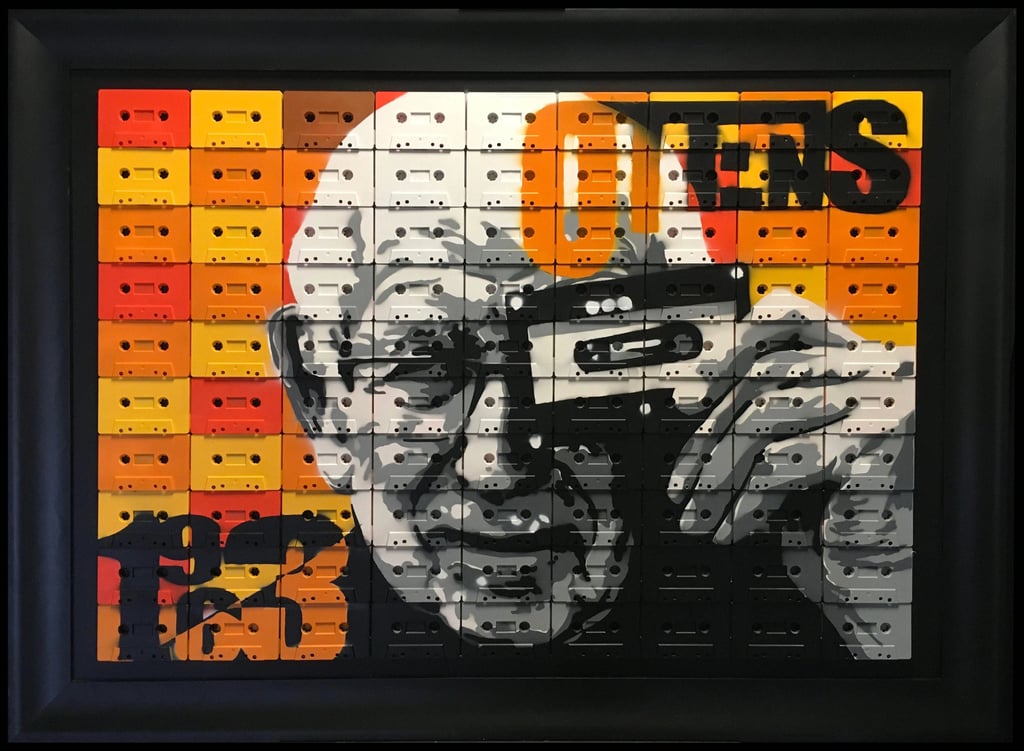
The audio cassette was born in 1963, developed by Philips. Initially, it wasn't a cult object. It was designed for voice recording, dictation, and professional use. A functional, economical, and standardized tool. But its simplicity was its strength: compact, robust, easy to copy, accessible to the masses. Very quickly, the cassette transcended its initial purpose. It became a popular music format, an everyday medium. Music left the living room and entered our pockets.
When the cassette transforms our relationship with music
With the arrival of the Walkman in the late 1970s, the cassette tape became synonymous with freedom. It allowed for personal, intimate, and mobile listening. For the first time, everyone could create their own soundtrack. Mixtapes emerged. They weren't simply compilations: they were stories, messages, sometimes declarations of love. The cassette tape became an emotional object, laden with memories. This strong emotional connection partly explains why it will never truly disappear.
Underground support, a free distribution tool
The audio cassette also plays a major role in alternative cultures. Punk, hip-hop, metal, experimental music: underground scenes embraced it massively. Inexpensive, easily duplicated, and independent of industrial circuits, it allowed for the unfiltered distribution of music. Long before the internet, the cassette was a tool for self-production and cultural resistance. This marginal, free, and imperfect status still contributes to its mystique today.
An imperfect object, therefore profoundly human
Technically, the audio cassette is fragile. The sound degrades, the tape wears out, and hiss is present. But this imperfection becomes a strength. Each cassette ages differently. Each listen alters the object. The cassette is never neutral. It bears the marks of time. It is precisely this materiality, this vulnerability, that makes it a powerful artistic medium.
From music to art: the cassette as a medium for artwork
Today, the audio cassette has definitively transcended its utilitarian function. It has become a raw material, a plastic medium, a visual symbol. Contemporary artists are appropriating it to explore memory, sound, popular culture, and technological obsolescence. Transforming a cassette into a work of art is not about recycling an object: it's about activating its history. Each cassette carries within it an invisible promise: a voice, a piece of music, a silence. Even silent, it tells a story.
The audio cassette is at the heart of my artistic work
In my work, the audio cassette is not simply a medium. It is the starting point. A popular object, linked to music, recording, and intimacy, it embodies a collective memory. By transforming it into a visual artwork, I play with the tension between what we see and what we imagine we hear. The cassette then becomes: a frozen object, yet imbued with sound, a repurposed archive and a bridge between musical culture and contemporary art. Each piece questions our relationship to the past, to reproduction, to the traces left by the technologies we abandon.
Why the audio cassette still fascinates today
If the cassette tape is making a comeback in contemporary art, it's not out of easy nostalgia. It's because it raises very current questions: What will remain of our digital media in 20 years? What becomes of memory when everything is dematerialized? What value does an imperfect object have in the age of infinite data flow? The audio cassette, through its finite nature, its limitations, its physical form, offers a silent resistance to the all-digital world.
Conclusion
The audio cassette is no longer a mere relic of the past. It is a living cultural artifact, a creative medium, a tool imbued with meaning. From music to art, it continues to evolve, transform, and tell stories. Far from being obsolete, it has become a contemporary platform for expression, where sonic memory, popular culture, and artistic expression intersect. And that is precisely why it deserves its place today… on the walls.