
The Art of Sound: How Music Influences Visual Creativity
Before starting a project, I need to know the artist. Their life, their choices, what they've been through. For DJ Mehdi, a documentary played on a loop at my place for three months. It's not a method, it's a necessity. Because what I'm trying to capture on tape isn't a face. It's a journey.
How I Choose My Subjects: Music as a Trigger
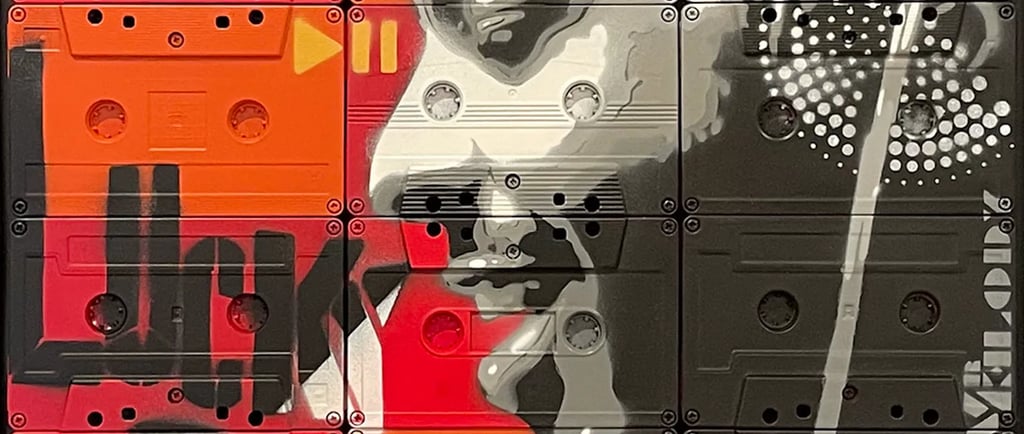
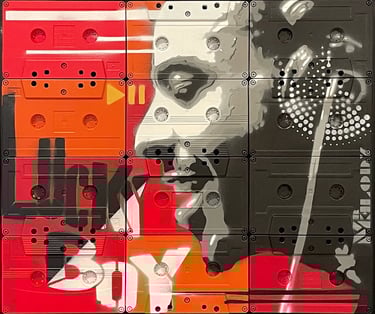
I don't choose an artist because they're famous. I choose them because they've moved me, through their journey, what they've built, what they've left behind. DJ Mehdi, for example. A kid who couldn't afford a sampler, so he made one. He transformed French rap and then electronic music, at a time when no one was bridging the gap between the two. And then this trajectory that climbs and climbs, and stops far too soon. When I put him on cassettes, it wasn't to illustrate his discography. It was to say that this kind of journey deserves to remain visible: not in a book, not in a documentary, but on a wall, in a living room, every day.
Knowing the Artist Before Touching a Cassette
Before starting a project, I do my research, really. I watch everything that exists: interviews, documentaries, archives. For DJ Mehdi, a YouTube documentary played on repeat for three months at my house. My wife was starting to lose patience. It's not a matter of method. It's a necessity. I can't put someone on tapes without knowing their life as if I were living it. The stencil captures a face, but what I'm trying to freeze is something else: an energy, a coherence between what the artist has lived and what they have produced. For that, you have to know. You have to have looked, read, listened until it becomes familiar. That's probably what people feel when they look at these portraits without knowing why. There's something in them that transcends physical resemblance.
The format follows the subject
For DJ Mehdi, nine cassettes. No more, no less. It's not an abstract decision; the subject dictates the format. The size of a work, the number of cassettes, the density of the composition—all of this is decided based on what the artist represents and what I want to convey. A global icon like Bowie might require hundreds of cassettes spread across several panels. An artist like DJ Mehdi, whose power lies in precision and economy of means, finds his true measure in something more concentrated: nine cassettes, a single gaze, and a work that fits in your hands before it fits on a wall.
What people are really buying
When someone acquires one of these portraits, it's rarely just for decoration. It's because they're fans, because this artist has been important in their lives, and because the cassette tape is part of their youth—this object they held in their hands, recorded, flipped, and rewound with a pencil. The cassette creates a dual emotional connection. It evokes the artist depicted and, simultaneously, a bygone era, a way of listening to music that no longer exists. People who buy these works aren't looking to own a decorative object; they're trying to preserve something that might otherwise have vanished. That's the real trigger for me too—not the musical style, not the fame, but the human journey behind the artist. What they overcame, what they invented, what they left behind despite themselves. The audio cassette isn't a coincidence in this context. It's an object that also disappears, that wears out, that falls silent. Putting DJ Mehdi on vintage cassettes is putting a fragile story onto a fragile medium. And transforming both into something lasting.
That's how I choose my subjects, not with my head, but with what music meant to me at a specific moment in my life.