
Why I work on audio cassettes rather than on a canvas
The audio cassette is not an easy medium. It's inconsistent, technical, and full of pitfalls. That's precisely why I chose it. Like tattooing on skin, working on a difficult surface demands a precision that canvas doesn't require.
Why I Work on Audio Cassettes Instead of Canvas
When people discover my work, the first question is often the same: Why cassettes? Why not canvas, a metal plate, or wood?
The short answer: because it's difficult.
The long answer is this article.
Twenty-five years of tattooing have taught me one thing: working on a technical, irregular, and dynamic medium demands a precision that neutral surfaces don't require. Canvas is forgiving. Skin isn't. Neither is a cassette tape.
When I was looking for a medium for my stencil work, I wasn't looking for something easy. I was looking for something challenging, something that imposes its constraints, something that demands precision.
The audio cassette was that medium.
A technical object, not a surface
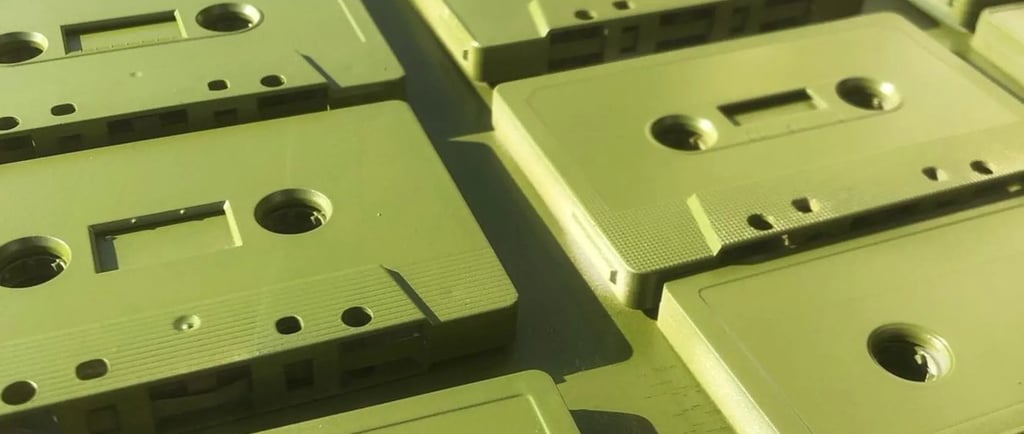
An audio cassette isn't flat. It has textures, gears, recesses, and areas that absorb paint differently. When you assemble dozens or even hundreds of cases to compose a portrait, you're working with an entire topography, not a uniform surface.
The stencil has to conform to all of that. The face has to be centered, taking the mechanisms into account. One eye falling on a gear, and the whole gaze disappears. I've recreated entire pieces for this kind of detail.
This technical constraint isn't an obstacle. It's what gives the result its value. When the portrait works on this medium, it truly works.
What the cassette offers that the canvas doesn't
A canvas is neutral. It has no history before you touch it. An audio cassette has already lived. It has contained music, voices, recorded silence. It has been held in hands, turned over, rewound. Some still bear handwritten inscriptions, titles written in ballpoint pen forty years ago.
When it becomes the support for a portrait, it is not blank. It arrives with something inside. And this something remains present in the final work, invisible but real.
That's what I would call density. A new canvas doesn't have it. A cassette found at a flea market does.
Is it recycling?
I'm sometimes asked this question from an ecological perspective. I'm not going to pretend that's my primary motivation.
I hunt for cassette tapes every Sunday because those are the objects that interest me, not to reduce my carbon footprint. The environmental impact is there: hundreds of plastic cases that don't end up in the landfill, but it's secondary.
What interests me is the material itself. Its resistance, its history, the constraints it imposes, just as skin imposes its constraints on a tattoo artist. The challenging medium forces you to be better. And when you succeed, the result carries that challenge within it.
That's why I work on cassettes rather than on canvas.